Introduction
Factory floors have changed a lot over the years. Not just in terms of machinery or production speed, but in how teams function. There are more specialized roles now. Compliance checks happen more frequently. Documentation matters more.
Because of that, factory safety clothing has quietly moved from being a routine purchase to something more strategic. It is not only about meeting industrial safety gear requirements anymore. It affects how people move, how they feel during long shifts, and even how consistently they perform their tasks.
Some companies still treat uniforms as standard inventory. Others take a more deliberate approach and work directly with Uniform Manufacturers in India to match fabrics and design with their actual factory environment. The difference between the two approaches becomes obvious over time.
Uniforms might seem like a small detail in large operations. In reality, they sit closer to daily performance than most managers initially assume.
Why Factory Uniforms Matter Today
Changing Workforce Diversity in Manufacturing
Manufacturing teams are not uniform in any sense. Age groups vary widely. There are more women working on shop floors than before. Some employees are physically active throughout the shift, while others operate equipment that requires a steady posture.
When uniform design does not reflect this variety, issues surface gradually. A sleeve that feels fine for one person may feel restrictive to another. A standard cut might suit some body types but not others.
Companies that update their sizing structures and patterns often notice something simple but important: fewer quiet complaints. Workers adjust faster. Acceptance improves.
Why One-Size-Fits-All Uniforms No Longer Work
“One size fits all” sounds efficient in procurement meetings. On the ground, it rarely works that cleanly.
Loose fabric around machinery is not ideal. Tight fits during lifting tasks are equally problematic. Workers do not always escalate these concerns formally. They adapt, which usually means adjusting clothing throughout the day.
That repeated adjustment reduces comfort. Over time, productivity is affected in subtle ways. Properly structured factory safety clothing reduces this friction before it becomes a larger issue.
Impact on Worker Morale, Confidence, and Efficiency
Clothing influences mindset more than people openly admit. When uniforms fit well and look structured, workers tend to feel more composed. There is a certain psychological benefit to wearing something that feels designed for your role.
If the opposite happens, and the uniform feels heavy or awkward, attention shifts away from the task. Minor distractions accumulate. During eight to ten-hour shifts, those distractions repeat often enough to matter.
When comfort improves, focus improves. The link is not dramatic. It is steady.
The Role of Comfort in Factory Workwear
Ergonomic Design for Long Shifts
Factory work involves repetition. Bending. Reaching. Turning. Standing for extended periods. Clothing should not resist these movements.
Ergonomic design focuses on small structural decisions. Seam placement, panel shaping, reinforcement that adds durability without stiffness. Workers may not notice these elements immediately, but they notice when they are missing.
Over long shifts, natural movement makes a difference.
Freedom of Movement and Reduced Fatigue
Lightweight safety uniforms are becoming more common for a reason. Heavy fabric increases resistance. Stiff material restricts motion. Stretch panels or flexible weaves allow smoother movement.
The result is not dramatic at first. By the end of the shift, however, reduced strain becomes noticeable. Employees often describe it simply as feeling less worn out. That alone contributes to better overall morale.
Breathable and Skin-Friendly Fabrics
Heat is part of most industrial environments. Machinery generates warmth. Ventilation varies across facilities. Breathable fabric helps manage internal temperature without adding bulk.
Skin comfort also plays a role. Rough materials cause irritation, particularly in humid climates. Choosing softer, more skin-friendly textiles reduces complaints and improves day-to-day wearability of industrial safety gear.
Proper Fit for Every Worker
Fit cannot be reduced to small, medium, or large. This includes parts that can be changed, cuts that are well-thought-out, and sizes that are right.
When properly fitted, clothing helps with safety, rather than hindering it. A worker walks naturally. The uniform maintains its shape. Professional appearance and functional practice are more compatible.
Safety Standards Every Factory Uniform Must Meet
PPE Compliance and Worker Protection
Safety requirements vary by industry. Some environments require flame-resistant material. Others need protection from chemicals or minor impact hazards.
Factory safety clothing must comply with sector-specific standards. Verification is part of responsible management. Protection cannot rely on assumptions.
High-Visibility and Hazard Awareness
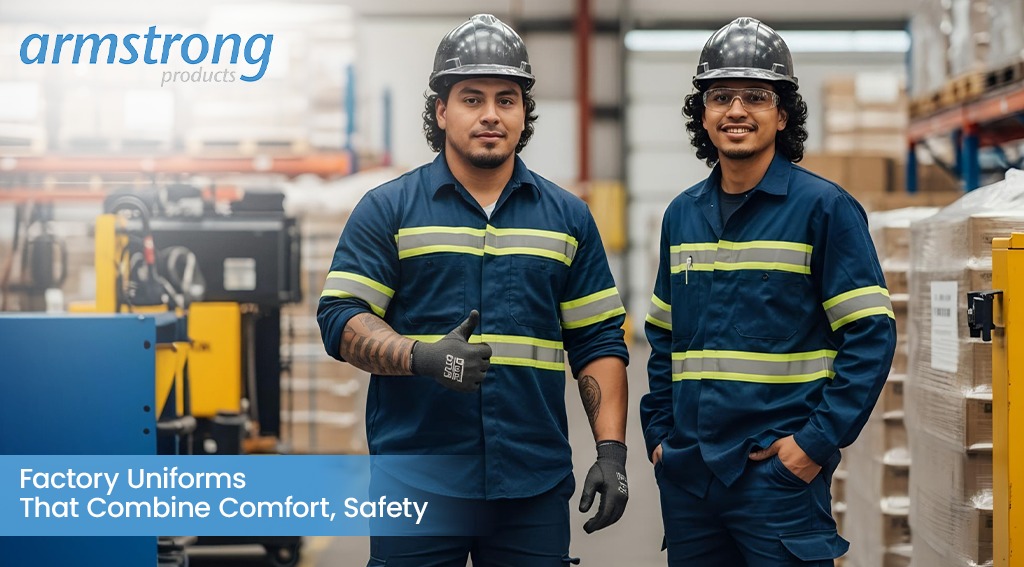
Busy production areas demand visibility. High-visibility colors and reflective detailing increase awareness around moving equipment.
This is one of those features that seems simple but carries real weight. Clear visual recognition reduces confusion and improves coordination between teams.
Reflective Elements and Role-Based Color Coding
Reflective strips support low-light operations or night shifts. They add safety without affecting comfort.
Color-coding departments is another practical approach. It’s easy for supervisors to see roles. It can be easier to talk to each other because you don’t have to say out your identification every time you talk to someone.
Durable Materials for Industrial Use
Factory environments are demanding on clothing. Frequent washing cycles, dust, oil exposure, and mechanical friction weaken low-quality fabric quickly.
Durable textiles and reinforced stitching extend garment lifespan. That consistency reduces replacement frequency and helps maintain a cohesive appearance across teams.
Key Features of Factory Uniforms
Extended Size Ranges
Workforces include a wide range of body types. Offering extended sizing acknowledges that reality.
When employees receive uniforms that actually fit, alterations decrease. Satisfaction improves quietly but noticeably.
Flexible and Stretchable Fabrics
Stretchable materials adapt to daily movement without losing structure. They retain shape after repeated washing.
This makes lightweight safety uniforms suitable for roles that involve both precision tasks and physical labor.
Easy-to-Wear Closures and Adjustments
Closures should be secure but simple. Good-quality metal zippers and snap buttons also help to reduce hassle. Adjustable elements allow small personal modifications.
Overly complicated fastenings create inconvenience and sometimes safety risks near equipment. Simplicity works better.
Climate-Appropriate Materials
Climate influences comfort more than expected. Warmer regions benefit from breathable construction. Cooler facilities may require layering options.
This selection of material according to working conditions can guarantee its usage throughout the year without compromising safety.
Choosing the Right Factory Uniform Partner
Industry-Specific Uniform Solutions
Food processing, automotive production, chemical handling. Each environment carries distinct risks.
A supplier familiar with industrial realities designs accordingly. The standardized solutions rarely address requirements related to a specific sector in detail.
Quality Control and Consistency
Uniform programs work on a big scale. It is important to maintain consistency when it comes to fabric, stitches, and color matching.
If a company have strong quality control, it can make sure that all batches are the same. This will also protect the company’s professional image.
After-Sales Support and Scalability
Factories expand. Workforce numbers fluctuate. A reliable supplier must scale production while maintaining quality.
After-sales coordination for replacements or additional sizing simplifies long-term management.
Why Armstrong Products Is the Right Choice for Factory Uniforms
Experience in Industrial Workwear
Armstrong Products has worked within industrial segments for years. This level of experience helps us to create practical design choices suited to factory conditions.
We see uniforms as more than just layers of protection. Instead, we see them as means for doing the jobs well.
Commitment to Comfort, Safety, and Inclusivity
Inclusive sizing and ergonomic considerations form part of our development process. Along with compliance, comfort is also discussed.
For us, safety requirements are still very important for any type of product.
Custom-Designed Factory Uniforms
We offer customisation so that you are free to pick the materials, colour schemes, and safety features as per your requirements. Armstrong Products provides flexibility instead of fixed templates.
Such a balance promotes branding without compromising protection.
Quality Assurance and Compliance Standards
Processes of inspection are devised in such a manner that uniformity of quality is achieved. Checks for compliance are carried out before distribution.
Such consistency builds dependable supplier relationships.
Conclusion
Factory uniforms now operate at the intersection of safety, comfort, and durability. Thoughtfully designed factory safety apparel helps people get things done every day. Lightweight safety outfits help you stay awake. Reliable industrial safety gear keeps up with safety standards.
Partnering with experienced Uniform Manufacturers in India helps organizations align protection requirements with practical working conditions. A considered uniform strategy supports both operational performance and worker well-being.
Frequently Asked Questions
What Are Factory Uniforms?
Factory uniforms are garments developed for industrial settings. They provide protection, allow ease of movement, and maintain a structured workplace appearance.
Why Is Comfort Important in PPE?
Comfort encourages correct and consistent usage. When protective clothing feels manageable, workers are less likely to adjust or misuse it. Reduced discomfort also lowers fatigue across long shifts.
How Do Uniforms Improve Factory Safety?
Uniforms enhance visibility, provide hazard protection, and simplify role identification. When properly designed, they reduce risk and contribute to safer operational flow.